At Perfect Motion Physiotherapy in Adelaide, we specialise in identifying and correcting faulty movement patterns that contribute to pain, poor posture, and recurring injury. Whether you’re recovering from a condition or aiming to improve function and prevent setbacks, our experienced physiotherapists help retrain your body to move efficiently, safely, and with confidence.
What Are Faulty Movement Patterns?
Faulty movement patterns arise when the body compensates for pain, weakness, stiffness, or imbalances — leading to movements that are inefficient or harmful over time. These can develop from:
- Previous injuries or surgeries
- Chronic or acute pain causing muscle inhibition
- Overuse of dominant or overactive muscle groups
- Prolonged postural habits (e.g., slouching or sitting)
- Neurological conditions or poor coordination
- Improper exercise or lifting techniques
Left uncorrected, these patterns increase the risk of injury, overload, and long-term dysfunction.
Signs You May Have Faulty Movement Patterns
- Recurrent pain or injury on the same side
- Movement that feels awkward, restricted, or unbalanced
- Poor posture or visible body asymmetry
- Gait changes or uneven weight-bearing
- Localised tightness or recurring muscle soreness
- Difficulty activating certain muscles during activity
Comprehensive Movement Assessment
Our physiotherapists begin with a detailed movement assessment to uncover hidden dysfunctions. We assess:
- Posture and body symmetry
- Muscle activation and inhibition
- Movement control and coordination
- Gait, balance, and joint loading
- Muscle overactivity or underuse
- Pain-provoked compensations
This allows us to identify exactly what needs to be corrected — and how.
How We Correct Faulty Movement Patterns
Our comprehensive approach combines advanced physiotherapy techniques for long-lasting correction:
- Exercise Therapy
Targeted exercises to activate inhibited muscles and de-load overactive ones.
Motor control and movement retraining.
Supervised progression with a focus on form and function. - Manual Therapy & Joint Mobilisation
Restores range of motion in stiff or restricted joints.
Allows for more natural, pain-free movement patterns. - Postural Retraining & Movement Re-education
Rebuilds awareness of alignment and technique.
Improves daily movement habits, walking, lifting, and sitting. - Taping Techniques
Kinesio taping to promote postural cueing and proprioceptive feedback.
Rigid taping for temporary joint stability and movement support. - Dry Needling for Trigger Points and Pain Relief
Targets myofascial trigger points — tight, irritable knots in muscle tissue that refer pain, limit mobility, and disrupt motor control.
Especially effective in addressing deep muscular restrictions that aren’t resolved with stretching or massage alone. - Soft Tissue Release for Mobility and Muscle Length
Reduces myofascial adhesions, tightness, and restrictions that interfere with movement.
Improves tissue pliability, reduces barriers, and supports improved range and control. - Electro Physical Agents
Interferential Therapy (IFT) for pain modulation and circulation.
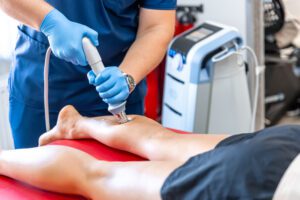
Ultrasound Therapy to aid tissue healing and reduce inflammation.
Pulsed Electromagnetic Field Therapy (PEMF) to stimulate cellular repair and nerve recovery.
Taping vs. Bracing for Movement Support
| Feature | Taping | Bracing |
|---|---|---|
| Custom Fit | Highly customisable | Standard sizes with limited adjustability |
| Feedback for Correction | Excellent for proprioceptive cueing | Limited or none |
| Stability | Moderate, good for short-term support | High, suitable for instability or post-surgery |
| Functional Movement | Allows near full range of motion | May restrict functional movement |
We help determine which option best supports your recovery and movement correction needs.
Why Physiotherapy-Led Movement Correction Works
- Based on detailed assessment and real-time feedback
- Provides effective therapy to improve tolerance to exercise and movement retraining
- Continuously monitored and adapted as your body improves
- Focused on treating the root cause, not just symptoms
- Integrated with hands-on techniques and evidence-based modalities
We ensure every session moves you closer to better movement, strength, and confidence.
Book an Appointment for Movement Correction
If you feel like your body is moving inefficiently, compensating, or contributing to pain — we can help you reset and move forward.
Contact Perfect Motion Physiotherapy in Adelaide today to schedule your movement assessment and take the first step toward lasting correction and pain-free movement.